
Menopause & Insulin
Natural hormone balance for menopausal women who refuse to merely survive it.

Insulin
The Fat-Storing Hormone
“Doc, I barely eat. I eat clean. I have tried every diet known to women. So why, now that I am in menopause, won’t this excess weight budge?”
Once you enter menopause, your ovaries stop producing many of the hormones that once made fat burning easier.
And here is the difficult truth:
“You cannot burn fat without fat-burning hormones.”
To lose menopausal weight, you must learn to play a different game.
I call it the Insulin-Glucagon Seesaw Game, and it is the most consistent fat-burning strategy I have found during menopause.
And remember:
Menopause begins the moment estrogen misses its mark and ovulation no longer occurs.
OPEN UP!
It was Halloween in the late 1960s.
I had already made it home before curfew. My pillowcase, my candy bucket of choice, was heavy, but not full. There was still room.
There is always room when you are a boy chasing Almond Joys.
Children were still trick-or-treating in the neighborhood, so I asked Mom if I could make one more quick pass through the streets behind our house.
To my surprise, she said yes.
I slipped through the backyard, down the alley, and along the dirt path leading to Phoenix Avenue.
Most porch lights were already off.
No light meant no candy.
Simple rules.
But one house still glowed in the middle of the block.
I walked onto the porch and knocked.
Suddenly, a group of teenagers appeared behind me.
They dumped a pile of garbage into the front yard.
I froze.
One of them splashed lighter fluid onto the pile.
Another lit it.
I started pounding on the front door.
OPEN UP!
I could hear movement inside.
Voices.
I pounded harder and yelled louder.
OPEN UP!
But no one opened the door.
When I turned around, the fire had exploded into towering flames.
The teenagers disappeared as quickly as they had arrived.
Only their laughter remained.
I ran home as fast as I could.
The Moral of the Story
Insulin is the key to your cellular entrance doors.
When blood sugar rises after a meal, your pancreas releases insulin.
Insulin unlocks your cells’ entrance doors so glucose can move from the bloodstream into the cell, where it can be used for energy.
Without insulin, blood sugar would rise to toxic levels.
But as we age and gain weight, insulin often has a harder time unlocking those cellular entrance doors.
This is called insulin resistance.
When insulin struggles to open the doors, blood sugar remains elevated.
The higher the blood sugar rises, the more damaging it becomes.
“Chronically elevated blood sugar slowly caramelizes the body from the inside out.”
In response, the pancreas releases even more insulin.
The knocking becomes louder.
Harder.
More desperate.
Eventually, the cells stop listening.
A QUICK NOTE FROM DOC
Next week, I am writing about something every woman in her Third Act needs to understand. Your fat cells have exit doors.
Most women never find them, not because they lack willpower, but because nobody ever showed them where to look.
Next Monday, I will show you exactly how to open those doors and teach your body to burn fat as its primary fuel — so that slenderness in your Third Act is not a struggle. It is simply what happens.
That article is free. But only if you are subscribed.
Subscribe below, it takes 30 seconds, and it will be waiting in your inbox Monday morning.
And if this article resonated with you today, tell me in the comments. I read every one of them. Your words let me know I am writing the right things for the right people.
The Train Whistle
22 Years ago, I built a home near a lake.
What I did not realize when I purchased the property was that an Amtrak station sat nearby.
Every night, trains passed through the station, blowing their whistles.
Some engineers apparently believed they were auditioning for a Peter, Paul, and Mary song.
At first, the whistles were annoying.
But over time, Vicky and I stopped hearing them.
Our brains adapted.
That is insulin resistance in metaphor form.
But when guests stay overnight, they almost always mention the whistles the next morning.
“You can hear those train whistles blow from 100 miles!”
That is insulin sensitivity.
Sensitive cells hear insulin.
Resistant cells no longer do.
What Happens During Insulin Resistance
Your Fat Cells Become Inflamed
High insulin levels cause fat cells to enlarge.
As fat cells expand, immune cells called macrophages move in and release inflammatory proteins called cytokines.
What was once simple fat storage becomes a chronic inflammatory event.
A Silent Battle Begins
Elevated insulin activates inflammatory messengers such as TNF-alpha, IL-6, and IL-1 beta.
This creates low-grade chronic inflammation.
You may not feel it directly.
But it quietly accelerates:
Heart disease
Diabetes
Stroke
Alzheimer’s disease
Certain cancers
You Store More Fat
Insulin strongly promotes the storage of visceral fat.
This is the dangerous fat surrounding the liver, heart, kidneys, and abdominal organs.
Visceral fat is far more metabolically harmful than the softer fat found beneath the skin.
Healing Slows Down
Chronically elevated insulin interferes with the body’s repair systems.
Circulation worsens.
Cellular healing slows.
In advanced diabetes, this impaired healing can become so severe that wounds refuse to close.
Inflammation and Insulin
Inflammation drives insulin resistance.
Insulin resistance raises insulin.
Elevated insulin increases fat storage.
More fat storage increases inflammation.
And the cycle continues.
This is why I believe one of the most powerful actions any middle-aged person can take is this:
Eat in a way that consistently keeps insulin low.
Not occasionally low.
Consistently low.
Insulin’s Three Plans
When insulin opens your cellular doors, and glucose enters the cell, your body has three possible plans for that glucose.
Plan A
Burn glucose immediately for energy.
Plan B
Store glucose as glycogen in the muscles and liver for future use.
Plan C
Convert excess glucose into triglycerides and store it as body fat.
This final process is called de novo lipogenesis — the creation of new fat from sugar.
Most menopausal women unknowingly spend much of their day trapped in Plan C.
Insulin and Estrogen
Before menopause, estrogen helped maintain insulin sensitivity.
It helped insulin open the cellular doors more efficiently.
As estrogen declines, you become more resistant to insulin, but several other problems occur that also make you more resistant to insulin.
And they all happen simultaneously:
Muscle Mass Decreases
Muscle is the primary location where glucose is absorbed and utilized.
Less muscle means less blood sugar clearance.
Cortisol Rises
The stress hormone raises blood sugar and insulin levels.
Sleep Becomes Lighter
Even a few nights of poor sleep can worsen insulin resistance.
Together, decreased muscle mass, elevated cortisol, and poor sleep dramatically increase insulin resistance.
And elevated insulin makes menopause significantly messier.
Dieting Is Not The Answer
This is one of the greatest misunderstandings in menopause.
When insulin levels are elevated, aggressively cutting back on food intake backfires.
Here is why:
Severe caloric restriction raises cortisol
Elevated cortisol raises insulin
Elevated insulin blocks fat release
So women diet harder.
And the body responds by locking fat down even tighter.
The scale refuses to move.
Willpower gets blamed.
The woman blames herself.
But this is usually not a willpower problem.
It is a hormonal misunderstanding.
The rules changed.
The strategy must change with them.
After 46 years of practice, I have learned one truth that rises above almost all others:
“To lose weight after becoming hormonally challenged in menopause, you must bottom out insulin and keep it bottomed out.”
Read that again.
Slowly.
Let it settle in.
“To lose weight after menopause, you must bottom out insulin and keep it bottomed out.”
How to Bottom Out Insulin
1. Stop Spiking It
Insulin rises most aggressively from:
Sugar
Refined low-fiber carbohydrates
Constant snacking
Liquid calories
If you want to lose menopausal weight, these four habits must go.
2. Eat Protein First
Protein creates a stable hormonal foundation for the meal.
Protein-rich foods have a very low glycemic load.
When protein is eaten first, the blood sugar impact of the rest of the meal is reduced.
Protein also:
Preserves muscle mass
Improves satiety
Stabilizes blood sugar
The order matters.
Protein first.
High-fiber vegetables second.
God made fats alongside them.
3. Stop Raising Insulin Between Meals
Every time you eat, insulin rises.
If you snack constantly, insulin rarely has time to fully bottom out.
This is especially common in men.
Men graze.
If you graze, stop.
“Spacing meals gives insulin time to fall.”
This is not deprivation.
This is physiology.
When true hunger arrives:
Eat a Meso-Meal.
Do not snack.
Eat when hungry.
Stop when satisfied.
A Meso-Meal consists of:
Clean animal protein
High-fiber vegetables
God-made fats
4. Lower Stress Before Lowering Calories
Cortisol raises insulin.
If stress remains elevated, fat release becomes difficult regardless of caloric intake.
Before meals, try:
Prayer
Breathwork
Quiet reflection
Pause and Breathe
These calm the nervous system and improve digestion and insulin regulation.
5. Sleep
Stanford research has shown that sleep deprivation:
Reduces insulin sensitivity
Raises cortisol
Increases ghrelin (the hunger hormone)
Lowers leptin (the satiety hormone)
The result?
More hunger.
Higher blood sugar.
More fat storage.
“Sleep is metabolic medicine.”
And unlike most medicines, it costs nothing.
Vicky — In Her Own Words
“After I stopped ovulating, I gained weight so fast it hurt.
I dieted harder.
Exercised harder.
And got nowhere.
When my husband explained that deprivation dieting and excessive exercise were actually raising cortisol — which was raising insulin — which was locking fat down even tighter, I nearly cried with relief.
Not because it was easy to hear.
Because it finally made physiological sense.
The biggest shift for me was not eating less.
It was eating differently.
Protein first.
High-fiber vegetables.
No snacking.
And finally prioritizing real sleep.
Within days, the scale began moving downward for the first time since menopause.
Consistently.
Dramatically.
All the way back to my happy weight.”
— Vicky Mac
Doc’s Favorite Insulin Remedy
When true hunger arrives, build a Meso-Meal:
A palm-sized serving of clean animal protein
A handful of high-fiber vegetables
A dollop of God-made fat (extra virgin olive oil is my favorite)
Then follow these simple rules:
Eat real food
Eat in the right order
Eat only when genuinely hungry
Stop snacking
When insulin finally bottoms out, the body can once again access stored fat.
That is when fat burning begins.
Final Thought
Middle age did not remove your ability to lose weight.
It changed the hormonal rules.
In younger years, caloric restriction and exercise alone could move the scale.
But during the Third Act of life, insulin becomes one of the primary levers.
When insulin stays elevated, the body stores fat.
When insulin falls, the body can finally release it.
Learning how to manage insulin may be one of the most important skills for optimizing:
Hormones
Weight
Longevity
Discipline
And here is the beautiful part:
Insulin has a hormonal partner.
When insulin falls, glucagon rises.
When glucagon rises, fat can finally leave storage.
In the next chapter, we will explore glucagon — insulin’s forgotten twin.
In a Nutshell
“Middle age did not take away your ability to lose weight. Your hormones changed the rules. The old game of dieting harder and exercising harder no longer works the same way. You must now learn to play the Insulin-Glucagon Seesaw Game.”
This Week’s Usie
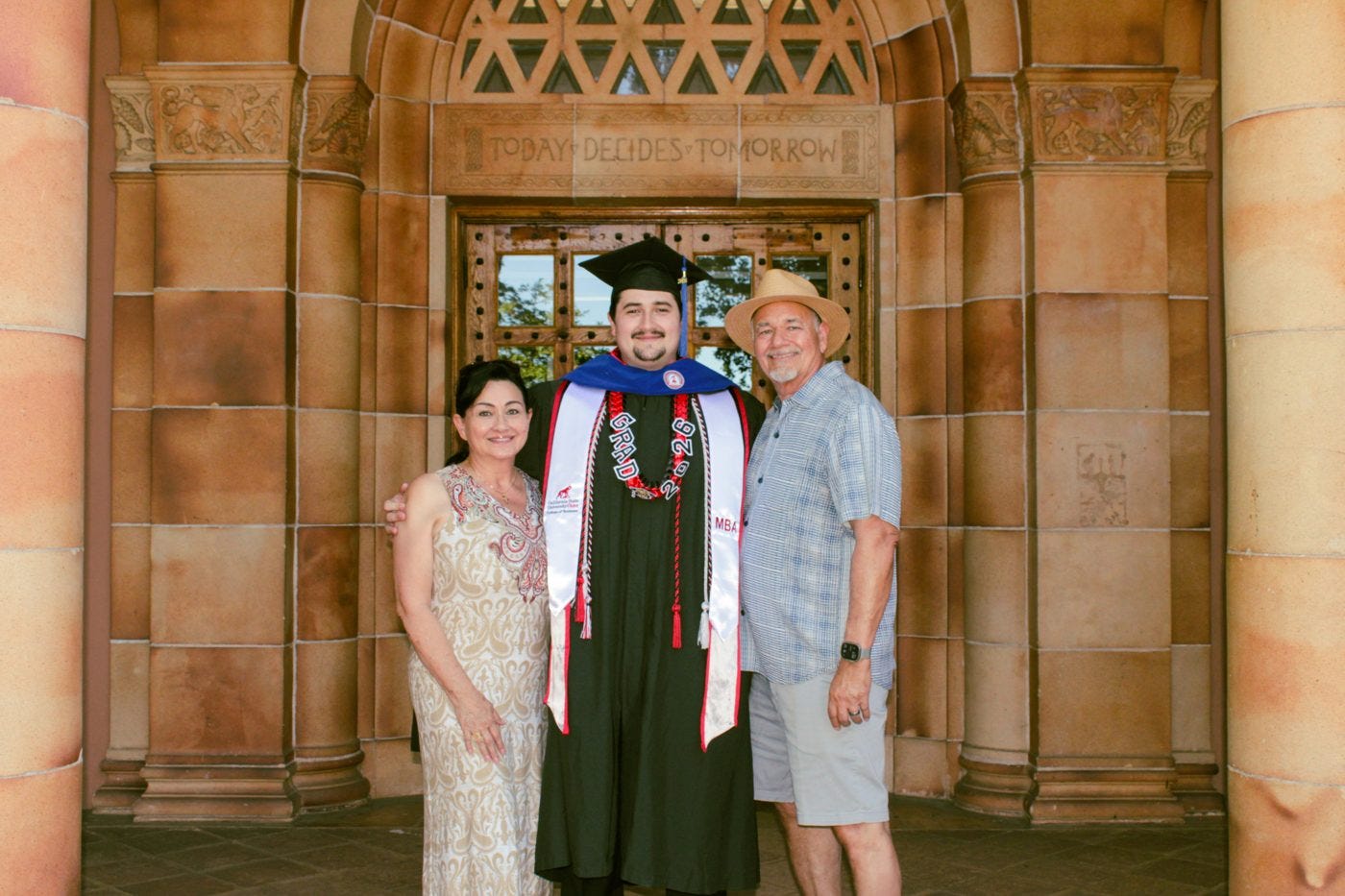
This week, our youngest son graduated with his MBA.
As Vicky and I stood beside him beneath the stone archway, I could not help but notice the words carved above the doorway:
“Today Decides Tomorrow.”
That may be one of the greatest descriptions of hormones, weight, discipline, and longevity I have ever seen.
Your future metabolism is being built by what you repeatedly do today.
Every meal.
Every walk.
Every night of sleep.
In every stressful moment, you learn to be quiet instead of feeding.
Today decides tomorrow.
Not someday.
Today.
And watching our son graduate reminded me of something else.
Meaningful transformations rarely happen quickly.
Degrees are earned one assignment at a time.
Healthy bodies are rebuilt one meal at a time.
Disciplined lives are built one repeated action at a time.
The future quietly grows inside the small choices nobody applauds.
Until one day, everyone notices.
Subscribe To My Substack
If this chapter from my new book resonated with you, I think you would deeply enjoy my Substack community.
Every week, I teach what 46 years of hormone and weight optimization practice taught me while helping thousands of women and men navigate menopause, andropause, weight resistance, aging, longevity, food, discipline, and hormones.
Subscribers receive:
Two weekly deep-dive articles
Practical hormone and weight tools
The HOPE philosophy in real life
Stories and parables that make complex physiology understandable
Strategies designed specifically for people over 50
To subscribe, click the button below:
Enter your email
Choose a free or paid subscription
Start using the tools immediately
And just get better one step at a time
And once you subscribe, you will have access to some of the greatest authors on the planet.
Paid subscribers receive the complete articles, advanced tools, protocols, and deeper coaching insights.
And yes — I write every article myself with, of course, a little help from Vicky.
If You Want To Talk To Me
If you have:
Gained weight despite eating well
Weight loss resistance
Loss of sleep
Hormone-induced anxiety
Low moods
Loss of interest in intimacy
Loss of motivation to socialize
Fatigue
Hormonal confusion
You do not have to figure this out alone.
I always make time for people who genuinely want help.
If you would like to talk with me personally, click the scheduling link and choose a time that works for you.
We will discuss:
Your hormones
Your metabolism
Your food preferences
Your schedule
Your symptoms
And what I would personally do if I were you
No pressure.
No hard sell.
Just a real conversation and a real plan.
And this week, the first two Substack subscribers who schedule a conversation will receive a very special gift:
Free access to our 7-Day Challenge beginning next week. It includes:
Daily accountability.
Daily guidance.
Daily customization.
Sometimes, one week changes everything.
And sometimes the life you miss is still waiting for you on the other side of balanced hormones.
SCHEDULE YOUR CONVERSATION BY CLICKING HERE
— Doc Mac
46 years of experience in hormone and weight optimization
Oh, and don’t forget to comment.
And share…
DISCLAIMER: The information in this article is for educational purposes only and is not intended to diagnose, treat, cure, or prevent any disease. It is not a substitute for professional medical advice. Always consult your physician before beginning or modifying any health program.
Love these articles. Menopause is rough🥹