


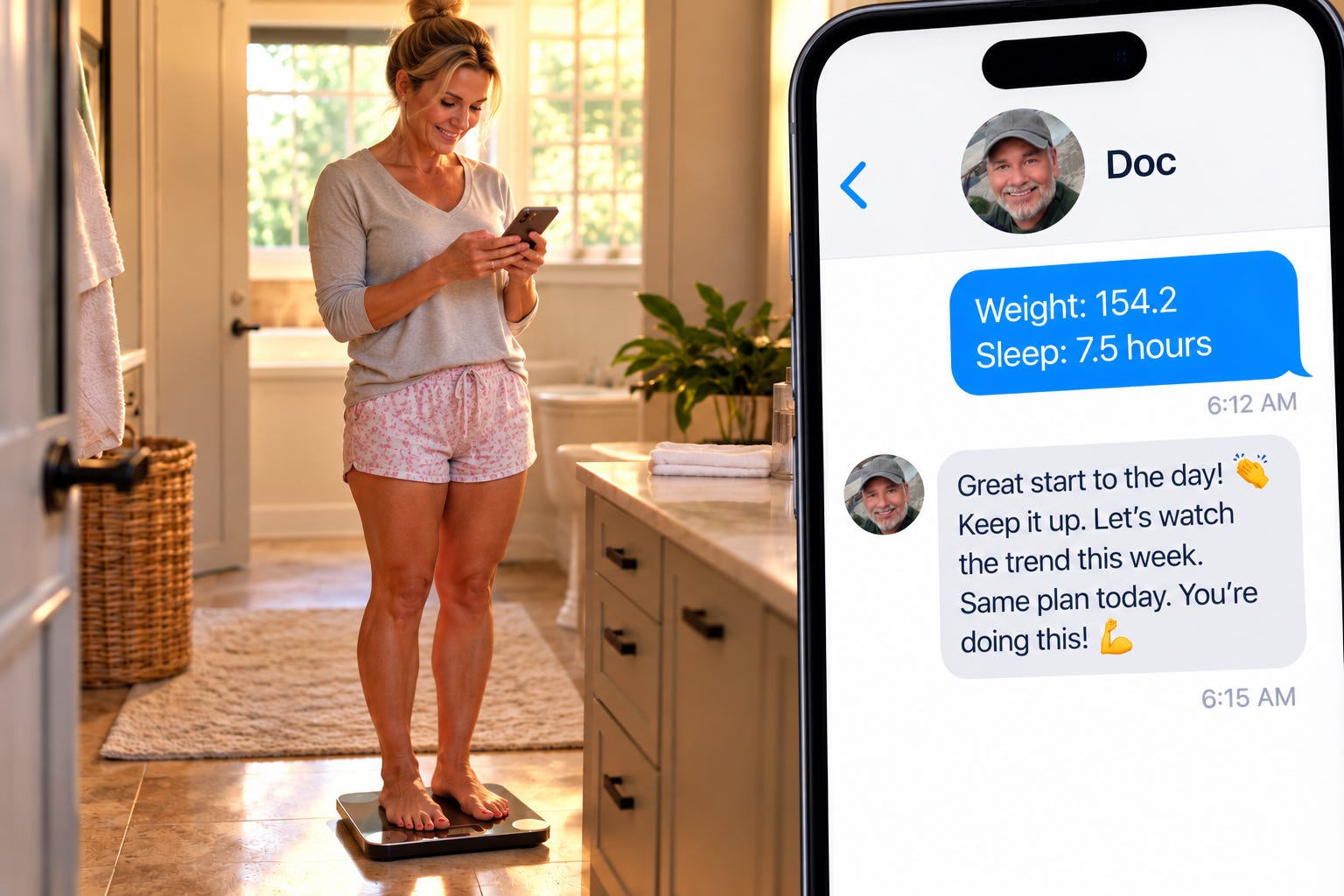
“Doc, do I really need to report my weight to you
—EVERY MORNING?”
“No.”
It’s Wednesday, my coaching day, and Susan is being Susan. I’ve got my AirPods in, my laptop open to her progress spreadsheet, and her latest numbers in front of me.
I pause, and Susan challenges my pause with silence.
Then I said, “But you’ll want to.
“In my experience of optimizing bodies, I have discovered that if my clients want to weigh less, those who text me daily reach their goals with much less frustration and more quickly than those who don’t.”
“But why do I also have to report my hours slept?” She asked.
“We have two primary goals during the first phase of this program.
“The first is to weigh less.
”The second is to age less.
“I have a good indication of how balanced your hormones are by how well you sleep. I have also found that the better balanced your hormones, the better you age. After forty-six years of practice and having helped over ten thousand patients, I can say with full transparency that:
“Those who text me daily, in nearly all cases, acheive their goals, and those who don't don't.
“Doc, you’re on the West Coast. I'm on the East Coast. What time should I text you?”
“Let me walk you through my first few minutes out of bed.
I have found that success is all about routines. I coach my clients by teaching them my routine from the moment I wake to the moment I fall into deep sleep. Next, I need to see how I did yesterday. Data is how we reach our goals of looking and feeling better.
“After I complete my breathing exercises and visualize and feel my four declarations… By the way, did you do yours this morning?”
“I did. I did the Three-Six Breathing, then the Five-Sense Awareness, then Thought Release, just like you advised. I had a little trouble with the Dream Reality exercise. I haven’t completely memorized all of my declarations—yet.”
“Well Done! It takes practice.
“Anyway, now it’s time for me to get out of bed and take my first action on creating the body I desire. I use the restroom, step onto the scale, and record my weight and hours slept.”
“How do you record them?” Susan asked.
“The same way you do. I text them to my coach.”
“You have a coach?”
“I have a coach for all four strands of my life. Me, Us, Them, and Him.”
“Four coaches!”
“No, I have a coach that specializes in all four strands of life, kind of a twin of me. My weight has been set for decades. I weigh the same as I did in high school.”
“What do you mean your weight is set? She asked.
“My weight stays in what I call a ‘weight room.’ There is a pun in there. For example, your happy weight, according to what you told me the first time we talked, was 135 pounds. Once you get there, we will maintain your weight in the 135 to 137 room.”
“Please tell me how to set my weight.”
“We’ll get to how to ‘set your weight’ when you get to your bottom, healthy, happy, ideal weight.”
“Bottom, healthy, what?”
I hesitate, but now is a good time to explain it. As I get to know Susan, I am surprised it took this long to ask me.”
“Your Bottom weight is the weight you achieve where, if we do a few of the stallbusters, your weight just won’t move.”
“Stall busters?”
“You’ll learn them one at a time when your weight loss stalls.”
“And what do you consider a stall?”
She’s good.
“It’s when you don’t lose weight for three days in a row.”
I move on quickly before we get sidetracked.
“Your healthy weight is a weight where the client wants to be healthier, usually defined by not having to get on medication or to normalize an abnormal blood test, like an A1c lab result that is too high, indicating prediabetes or diabetes.
“Your ideal weight is what your BMI says you should weigh for your height.
“Your happy weight is the weight that makes you happy.”
I move quickly back to what we were talking about.
“So, you’ll need to text me your weight and hours slept every morning. along with your weekly goal.”
“I notice that you want my week to go from Wednesday to Wednesday. Why?”
That’s one of the things I like about Susan. She wants the reasons. I've found that clients who understand what we are doing do better with commitment, discipline, and therefore achievement.
“I do that for two reasons. It gives you time to recover from the weekend. And I only do all my coaching calls on Wednesdays. Vicky and I are retired, and we are constantly traveling, so I make sure that I am stationary on Wednesdays.”
“So, why not just text you every Wednesday?”
“DO YOU EAT ONCE A WEEK?”
“Very funny. Why? My last weight-loss coach told me to stay off the scale because it would discourage me.”
“Is your scale discouraging you on this program?”
“Sometimes. Especially when I’ve been good all day, and the stupid thing goes up the next morning.”
“Susan, how much did you weigh yesterday?”
“154.2.”
“And today?”
“155.1. Almost a pound more! I followed the menu perfectly, Doc. How could I gain a pound?”
“Do you think you gained nearly a pound of body fat overnight?”
“Well, that’s what the scale says.”
“No. That’s what you think the scale says. Gaining weight and looking into what might have caused it is what makes this program so successful. We're customizing a menu to your hormones, body, health, and mindset.
“YOUR SCALE TELLS US MORE THAN WEIGHT?
“Your scale cannot distinguish the water you retained from yesterday’s salty dinner from changes in fat, muscle, glycogen, or the contents of your digestive tract.”
“Glycogen?” Susan asked.
“Glycogen is long chains of glucose tucked away for emergencies.”
I paused to redirect myself.
“Let’s say you had a particularly salty dinner last night. Your body might retain more water. Or perhaps you ate more carbohydrates than usual. Some of those carbohydrates can be stored as glycogen, and glycogen is stored with water.”
“So I could weigh more without getting fatter?”
“Exactly. And here’s something else. When glycogen is stored in your muscles, each gram is commonly associated with roughly three grams of water; of course, the amount varies from person to person.”
“Three grams?”
“Approximately. That means changes in your body’s carbohydrate stores can move the scale without representing an equivalent change in body fat.”
“So yesterday’s number wasn’t necessarily good news, and today’s number isn’t necessarily bad news?” Susan asked.
“Now you’re thinking like a coach.”
This is one of the most important lessons I teach my clients.
“The scale measures weight. It doesn’t explain weight.
“And that’s precisely why I don’t want to make decisions based on one morning’s weigh-in. I want you to see the pattern, the trend.
“THERE’S A DIFFERENCE BETWEEN A DAILY NUMBER AND A TREND
“Imagine you’re driving from Los Angeles to San Francisco. You check your GPS and discover you’re traveling north. A few minutes later, the road curves east. Would you assume you’ve abandoned San Francisco and you are now headed to Las Vegas?”
“Of course not.”
“You understand that roads turn while the overall journey continues toward your destination. Weight loss works much the same way. Some mornings your weight moves down. Other mornings it moves up. Sometimes it doesn’t move at all, even when you’re consistently following the program.
“What matters is the direction you’re traveling over time.
“That’s why I ask my clients to weigh themselves under reasonably consistent conditions: after waking, after urinating, before breakfast, and preferably on the same scale at the same time.”
“That reminds me of something. I noticed the other day when I ate late, I gained the next day even though I ate three perfect Meso Meals, just clean meat and vegetables.”
“Yes, weight frustration occurs nearly every time you eat later than usual.
“I do want you weighing at the same time every morning, as soon as you wake, but I have a little trick I use to record a more accurate number when I eat later than usual.
“I weigh later.”
“Oh, I see. When you say ‘the same time every morning,’ what you really mean is weigh in with the same amount of time passing since your last meal. That’s what gives you an accurate comparison.”
“Susan, I tell you that because you are like most of my clients; you like to win every day, and I will admit there is no better motivator than winning.
“If you eat the Meso Menu daily, you should win daily, but when you don’t win, it tells us a lot.
“If you are in your routine, your groove, you will lose weight nearly daily. I know if I had said that before you started the program, you would have scoffed. But now that you have experienced it, you realize that it’s true. I am looking at your stats, and you lost weight daily for 10 days and more than 10 pounds before you had a weight-gain day on day eleven.
“When you don’t lose weight, or you gain weight, that provides us with valuable data. We want to see what foods work and what foods don’t for your body, metabolism, and hormones.
“As you have discovered, the cleaner you eat, the more dramatic the stall or weight gain is when you veer from the menu.
“When you don’t lose weight on the Meso Menu, there was something you ate the day before that stalled your weight. For example, let’s say you ate at a restaurant. Restaurants use a large amount of salt. I’ve read that restaurants buy 70% of all salt purchased in the U.S.
“When I see that you stalled or gained and I ask what was different from your routine the day before, and you tell me you ate at a restaurant, there is no need to do a stallbuster day. You need to flush the salt. I’ll tell you to stay the course, but to drink an extra glass of water today.”
“But what if I gained and I stuck to your menu to a T?”
“That's why you weigh and text me daily. When you gain, as you have noticed, it's usually a frustrating type of gain when you stick to the menu. That means you may have eaten a food or spice you are sensitive to. When you eat a food that you are sensitive to, you’ll have an inflammatory response. It will usually be a large gain of at least a pound, and it can be up to three pounds.”
“Three pounds!”
“Yes, I see that happen weekly. And in some cases, especially if the client has stuck to the Meso Menu, it can come from a healthy food, like one of the vegetables on the Meso Vegetable List.
“So FOUR things can happen when you weigh in.
“One, you lose weight.
”Two, you stay the same.
”Three, you gain a few ounces.
”Four, you gain a pound or more.
“As you report to me daily, I can customize your weight loss menu and develop your maintenance menu.
“Let me tell you how I discovered a food that I am very sensitive to.
“I’m a Mejo. That means it is my duty to bring Menudo to my mom every Sunday. In our clinics, we offered food-sensitivity testing. We would draw blood, and a company would test your blood against certain foods. The more you paid, the more foods would be tested. Anyway, I tested my foods with this test so I could figure out why, on some days after lunch, I’d feel bloated and fatigued to the point that I yawned incessantly. My brain also made stupid mistakes, like completely losing my train of thought. That doesn’t work when you are trying to help a patient.
“I know that feeling,” Susan said.
“My test came back with 8 or 9 foods that I had severe sensitivities to. The worst or most reactive was oregano.
“So, I took my mother her Sunday morning Menudo. When you pick up your menudo, they have little cartons of onions, radishes, and oregano in separate containers.
“As I presented the menudo, I laid the container of oregano and other condiments around her bowl. She immediately used the back of her hand to scoot the oregano away from the bowl. I saw it and thought, ‘What the heck?
“Mom, why did you do that with the oregano?”
“Oh, I haven’t been able to eat oregano since I was a kid. It makes me sick.”
“There's another example of why we should always ask your mother first before you go and spend thousands of dollars on a food sensitivity test.
“So, can you see by weighing every day you can discover what foods work for you and what foods don’t?”
“So should I take one of those tests?”
“I have found the best way to test for sensitivities to foods is once you have eaten clean for a while, eat it.” There is no better way to test a food, and you’ll save thousands of dollars.”
“So what happened? Did you have to avoid those nine foods forever?”
“No. I fixed my gut and now only have sensitivities to two of those foods.”
I knew her next question would be, so I said, “The Gut Program is in Phase Two.
IN A NUTSHELL
In my forty-six years of having multiple clinics and helping thousands optimize their health, if you asked me what the most important part of our program is, it's… drum roll…
“Weighing every day.” Susan blurted out.
I smiled.
“Being held accountable daily.”
“When I was still practicing, around 2012, I surveyed the medical doctors, naturopaths, and chiropractors on staff individually. I wanted to know what we could do to make our one clinic better than the largest weight loss business in town.
“At the time, patients would come in, and we would weigh them, measure them, and provide any supplements they needed. Back then, we would refill their prescriptions.
“I looked for ways to take our patients’ successes to the next level. At that time, I had been practicing for 32 years, most of it in the same building. It was a busy practice, but it was one building and one practice.
My doctors came up with no good ideas. So I rounded up the rest of the staff, the nurses, massage therapists, the medical assistants, and we had a mastermind. I asked them what we could do to get even better results. My wife, a nurse and nutritionist in the practice, came up with…
“We do exactly what Weight Watchers do: we have our patients come in once a week. That’s why they are so successful as a franchise. But what if we took our patients’ accountability from once a week to daily?”
I thought about it for a moment.
“But we don't have the room to see that many patients every day. We are near capacity with them being monitored once a week.”
She scanned the staff members in the room. “What is the one thing Doc complains about the most?
“Our phones.”
Smartphones had found their way into everyone's purse or pocket.
She said, “Have them text their stats daily. We’ll put together a team that keeps them on track.”
“We did just that, and within 18 months we went from one clinic to opening up 7 satellite clinics throughout northern California.
“Three years later, we retired.
“So now you know.
“The most important component of all our weight optimization programs is…
“Daily Accountability.” Susan blurted.
“ YES!
“But you know what else I learned? If you need advice, ask your mother or your wife before you go down a rabbit hole.”
THIS WEEK’S USIE

WEIGH LESS · AGE LESS
Live Younger, Longer.
Doc & Vicky Mac
P.S. If you’ve tried everything to lose weight and nothing seems to work anymore, Vicky and I would love to hear your story.
Start with a free 15-minute conversation. We’ll discuss what’s been holding you back and whether our complimentary personalized protocol, review call, and seven days of free guidance are right for you.
SCHEDULE YOUR FREE 15-MINUTE CONVERSATION →
Disclaimer: This article is for educational purposes only and is not intended to diagnose, treat, cure, or prevent any medical condition. Daily weighing and self-monitoring may support weight management for some in. Still, resultst results vary, and frequent weighing may not be appropriate for everyone, particularly those with a history of disordered eating. Sleep duration is one indicator of health, not a direct measurement of biological aging. Consult your qualified healthcare provider before making significant changes to your weight-management or health program.